
Practicing with Night Vision

Louis Richards

LSB Member
So I finally read through the entire thread, or more so give it a serious glance. Somewhere between the two. It was a lot of reading. Got questions. Where did you get that nice yellow tray to clean your rifle on? Looks really nice.

Seems like you are placing a lot of importance on the stick. And I know there's other advantages as far as walking with it. Still? I never even considered one. I don't have that much problem from a standing position. It may be a hunting thing in fact I'm sure it is. For my situation, standing is never a good thing and laying prone and out of the way is best :)

I'm leaning towards a pair of one goggles. Envisioning two monoculars sticking out from my helmet just seems a bit much..
But one question that got missed, does a pair of goggles give you a better field of you than one monocular? If not, then I can't see any advantage whatsoever to get the goggles correct?

When can I come to Kansas?

What's your opinion on the new digital? I've heard the white offers a lot better clarity and all in all it has the edge in today's world.
 

wigwamitus

LSB Active Member
Goggles vs a pair of pvs-14s

Goggles look like this

https://****.com/wp-content/shopp_images/cache_320_320_0_100_80_16777215_MOD3_af.jpg

==
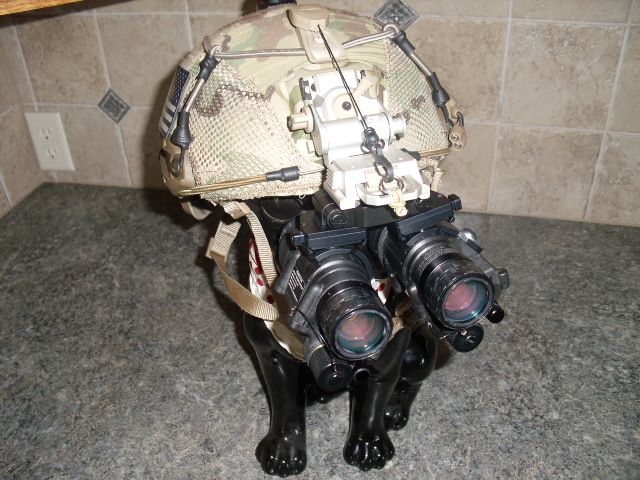
Dual 14s look like this

DSCI0451_zps8b3d1b00.jpg


==
... Envisioning two monoculars sticking out from my helmet just seems a bit much ...

So not much different

==
==
... Where did you get that nice yellow tray ...

Got a bunch of those "trays" they came with the cleaning kits ...

==
... Seems like you are placing a lot of importance on the stick ...

Right, around here between about May and Sept (if you cut your hay) or all year if you do not cut your hay ... then going prone puts you "down in the weeds" ... you can still shoot .. but you cannot see anything except the weeds or grass in front of you.
The stick is better than standing unsupported. At 500yds I can get 2 moa groups day or night with the stick, not so without. For about 150yds and under I use the stick for zeroing but do non-zeroing shooting standing unsupported.

==

ABNV MOD3 goggles **** price $6,900 but note the ABNV system is NOT the top of the line ... **** shows a price of $12,960.82 for a PVS-15 set of goggles. There are lots of choices in this field ranging in between the two pricing extremes.

two x TNV/PVS-14 g3 Omini VIII $6,190 ... integrated components bridge $550

Note, the ABNV goggles essentially comes with a built in bridge, but for the dual 14 solution you have to buy that separately to get to an "apples to apples" comparison perspective.

So surprisingly, the two duals plus the bridge are a little cheaper ... that's just poor pricing :) I think the ABNV unit is fairly new, so the price is still a little higher. **** probably sells truck loads of their TNV.14s so they are probably a "commodity" for **** and hence they have a low price. But I think LSB vendors can beat **** on price! Your mission is to prove me right!!! :D

The FOV is 40 degrees in either case. The advantages of dual 14s or goggles I've listed in previous posts, but will list again here:

01 - The googles will be a little lighter than dual 14s due to shared components, like switches.
02 - Having two (light) amplifiers in front of your eyes means twice as much light entering your eyes, means twice as much information reaching your brain. It makes it easier to see things.
03 - Two amplifiers providers depth of feild, this is perhaps the most important advantage as now you can better judge distances. This is especially useful for driving or operating other equipment (like helicopters).

A disadvantage of dedicated goggles is that you can't pull them apart to hand a lacking team member one of your 14s ... (the ABNV MOD3 unit actually works around that) but like the PVS-15 cannot be split into 2 units.

==

Come to Kansas whenever you like - with 2 weeks notice if you mean my place!

==
Digital ... I looked through a couple of ATN X-Sights (a 3x and a 5x) last January. Digital is certainly the wave of the future ... but we couldn't see beyond about 30yds with those devices at night. They were ok digital day cameras, but not showing us the "wave of the future" in terms of NV/Thermal at that time. I'd keep waiting if it were me.
 
Last edited:

Jhop

LSB Active Member
SUS VENATOR CLUB
I might take you up on coming by Eskridge Kanasas. I'm driving to Waubay South Dakota middle of October and coming back towards the end of it. Eskridge doesn't look like its too far out of the way. Send me a pm.
 

Louis Richards

LSB Member
Ahhhhh. I read your previous response yes, on the comparison of the two, but I got confused even though you clearly stated it under the subheading of goggles. But for some reason my brain, when I read having "two" means more light and more info, I went back in brains to thinking that meant two monoculars :) quite dumb actually now that I understand you were talking about goggles its become clear. I was like "then why the heck would anybody buy goggles"

Can't believe you're saying you didn't have any distance with the digital. I have a Bushnell equinox Z and I found it to be spectacular. In fact, my problem was the opposite, at faraway I didnt see anything, it was close up I had the issues with of course that's because I have 4X.

I don't have any intention of spending that much money on NV. I'm almost forcing myself to keep the BushNell and just get a laser. On the cheap so to say. It has a built-in mount but it's a beast and I doubt I would ever do that. That's perfect for shooting, but doesn't do much for my stumbling around in the woods issue. That's the only reason I want it for, to stomp in around the woods and spending that much money for that purpose is too much.

I remember reading an article about seals and I read that it took about 45 minutes for the human eye to completely get accustomed to the black night. After that you started to see a lot better.

Two weeks notice? Are you crazy? I'll just sneak on the property at night, you wouldn't have a chance in hell in spotting me..
 

wigwamitus

LSB Active Member
Looked at some pics and video of the bushy equinox Z ... and the images look fine ... but most/all of the night ones seem to involve some sort of light source ... which might be nearby visible light or the built in ir-illuminator. If you have or can use such light sources, then you might not need pinnacle 3p or L-3 filmless type technology. Out here in the country, we have little ambient light, unless the moon is up ... and it is hard to navigate around with just the MK1 and the stick (but can be done). And generally we prefer not to turn on ir-illuminators either. Some believe the critters can see or at least detect such and some videos would seem to support that theory. Also when hunting in groups ... if one guy turns on a mega illuminator it might wash out the image for those with better tubes on their heads.

==
But if you have the bushy already, then certainly keep using it and learn whether it meets your needs!
 

Louis Richards

LSB Member
The Bushnell has an excellent built-in illuminator. Extremely powerful to be honest. I have to say, I was really shocked at the digital night vision improvement. It blew me away that I can get such clarity for such a cheap amount of money. I was sold on digital from that point forward. I figured if $400 worth of digital got me that kind of a picture, I could only imagine what $3000 would get me.

It has three different illuminator settings and as many brightness settings. I'm telling you, for long distance now, the long distance only, bang for buck, this thing simply cannot be beat.

Unfortunately, it's absolutely useless for walking in the woods. For that I have my Bushnell nightwatch. It's cheap Gen one technology and a 2X and I may wind up just trying that combination first before I assume I need to spend more money
 

Louis Richards

LSB Member
But ultimately for walking around, I need a 1X and that's why am shopping again. OK, time for me to go to sleep I've been up all night and I need a nap. I mean I have another board meeting in 10 minutes..
 

wigwamitus

LSB Active Member
Aye, but understand military, LEO and many hunters do not want to use IR-Illum as a general rule. They want it on hand for occasional use, but they want to be able to do as much as possible in passive mode to maximize stealth. Hence the general avoidance of devices that need lots of ir-illum to function.
 

Louis Richards

LSB Member
Well, I don't think military or law-enforcement is spending $400 on night vision devices :) That's getting into some serious high-tech kind of stuff and I think will be safe for the average user. For the average user, looking to get their feet wet in night vision, I would highly recommend the Bushnell Equinox Z, in 4 or 6 X. Surprisingly, the 3X, unless I got a defective unit, did not give me as crisp a picture. So much so that as bad as I wanted as little magnification as possible, it wasn't worth the trade-off and I sent it back. I originally got the 6X but it was just so much magnification that you had to start off at 100 plus yards. Drop down to the four and got much better results but still to magnified for what I'm looking for. When I close my eyes at night, I envision night vision for close quarters I just always have. Maybe I watched too much TV and I read too many articles, of police and secret agents busting into buildings, warehouses and homes. And in those scenarios a 1X is all that's needed. But this I can say, when not looking to spend a second mortgage amount of money on the device, compared to the GEN one stuff that's out there, this is much superior and gives you a very close look at what $3500 can buy you.
 
Last edited:

wigwamitus

LSB Active Member
If the Bushy Equinox Z meets your needs that is great!

I'll have to try digital again one day ... but my first gen1 goggles were crap ... and the ATN X-sights I looked through were crap ... so I haven't been in a hurry ...
 

wigwamitus

LSB Active Member
... I read that it took about 45 minutes for the human eye to completely get accustomed to the black night. After that you started to see a lot better. ...

Yes, though even 15m makes a huge difference ... I read that as we get older our "night vision" gets a lot worse. If that is true the young people must be blinded out there at night ... because on foot with ANY moon I can see fine out in the open ... and I can drive the buggy in the open ... (not in the woods) ... it is about speed ... with the 14s I can go faster ... with more confidence ...
Around here it is bumping into rocks or stumps even in the open that tosses me onto the ground rolling along before I'm even aware I bumped something :) ... driving I worry about rolling into a gully I can't see ... but the 14s ... especially the duals go a long way to mitigating that.
 

Louis Richards

LSB Member
Night Vision Goggles

Alpha, Ghost and Bravo? Description to the untrained eye looks exactly the same. Any advice as to the differences between these three units? Think I want to get one of these.

PVS7 gen3. The other ones that start off the list on the first row I don't really know. But from what I understand the PVS 7 is the most widely used.
 

Louis Richards

LSB Member
PLEASE tell me that this is normal. Pretty dark night and it's been raining for hours. Just stopped and there is still a very very light sprinkle almost not noticeable. In fact you could say it's not raining but just after the heavy rain. For kicks I decided to take my Bushy Night Watch outside to see if I could use it to walk around the woods and no I cannot. I mean you can see clearly enough and easily see my fence 50 feet away and all my trees and bushes. But it's still not made to walk around as you would be looking at your feet and its 1.5 X.

But then I thought I pull out my 640. I couldn't see anything. I mean nothing. Totally blinded. Could barely make out my fence and a gigantic tree 30 foot away and I mean barely. When I say barely, I mean I couldn't even see it at first but so let down I concentrated really hard and barely saw faint shape of it. A complete grayish haze over everything. So bad that I thought my lens had fogged up for sure, but when it was clean as a whistle I started to worry. I am in white hot. My bushy hundred dollar unit look like $1 million device next to my 640...

I will feel much better if everyone tells me it's because of the weather and it just rained. But, those are conditions we actually will be in in real life. Very let down, very very very very let down. I changed it back to factory settings and the screen went a lot darker and it helped about 10%, but that's it.

Something tells me that night vision would've really shined in this situation .. Sad part is once again, I turned on my 4000 lumen TK 75 Fenix flashlight and it lit up 100 yards in all directions like it was high noon. I guess this is all about stealth and stealth only because if you REALLY want to see, a fast flight has got ALL technology easily WHOOPED...
 
Last edited:

wigwamitus

LSB Active Member
I call such conditions "mist" (and further sub-divide as light, regular or heavy mist) ... this (for me) includes fog ... and you might say "rain" that is not hard enough to even be called "drizzle" :). But "mist" creates the most challenging visibility conditions I have faced (dust and heavy smoke might be tougher).

This is normal.

Back earlier in this thread ... you will see myself and another member in Texas comparing notes on an extremely poor thermal performance night that was affecting both KS and TX. I was out with my buggy (Kubota RTV 1100) and realized I couldn't see well enough to meet my shooting goals, so retasked outing to just be visibility edge testing. The buggy was a "hot object" ... so I dismounted and headed farther away. IIRC I could detect the buggy at a maximum of 82yds with both the 42mm, 336(60) Apollo Thermal (as a handheld monocular) and the SAME distance with the PVS-14 and the LRF.

At 150yds, I could identify the buggy with the 14 with its 3x USGI magnifier attached.

At 200yds, I could detect the buggy with the 14 with its 3x USGI magnifier attached.

Note, I did not use ir-illum and would expect it to make things worse. In those conditions more of the ir-illum light bounces off the water than is able to make the trip down and back to my eyes.

The rain cools the terrain and vegetation to the point where everything is about the same temp ... and emmissivity differences are insufficient to separate out the land from the trees perhaps due to the presence of water on the trees and ground and rocks. With the thermal I saw solid grey beyond 82yds, except I could make out the tops of the tree lines relative to the sky ... but everything below the tops of the tree line were just sold grey, through the thermal.
With the pvs-14 on 3x I could detect out to 200yds and ID out to 150yds.

==
On another night with even heavier mist, I could not see targets at 60yds with anything.
With MKIEB I could see the berm where the targets were.
With tac light I could see nothing but mist and light shining back in my eyes.
With ir-illum I could see nothing but mist and light shining back in my eyes.
Without ir-illum I could see nothing (through PS-22).
So in this case only MKIEB could see anything :)

To see a target with NV or MKIEB the ambient light needs to come from its source and bounce off the target and come back to your eyes.
To see a target with ir-illum or tacLight the light from those sources needs to head down to the target, bounce off the target and come back to your eyes.
If the mist is heavy enough maybe not enough light can make those trips.

I've also been momentarily unable to see target due to gunsmoke (from my previous shot) with NV at night, depending on the wind conditions, etc. Sometimes for up to 10s and that would be BAD in some circumstances!

Life is full of trade-offs! I don't think any one technology trumps all conditions.
 

Louis Richards

LSB Member
" dust and heavy smoke might be tougher "

In watching many videos early on, One of the items that was touted heavily was the fact that you could see through smoke? In fact one of the videos on the website actually shows night vision compared to thermal vision through smoke inside of the house was on fire or something like that. Saying it was great for fireman. That's why I'm shocked to have you say smoke would be a worse condition?

And am I understanding you right to say night vision would've had the same issue with mist?
 

Louis Richards

LSB Member
I am leaving for Moab desert in Utah in a few days. I plan on taking the 4 x 4 and heading as far back in the back country as my truck will get me. This will be a great place that has lots of far distance points to check everything out and see how it does. Would like to get my hands on some my visit devices before I go :)

To all vendors who have contacted me earlier, you will see a posting of an Armasight NVS7 Alpha device that I'm interested in getting, will post this on the other thread also. But like to know the differences between those and your equivalent and what your best prices are :)
 
Last edited:

Louis Richards

LSB Member
"IR illuminators also offer better quality as they can perform high-speed video capture; see through darkness, mist, fog, rain and snowfalls"

See this is exactly why I am always confused is because there is so much contradictory information out there. Wig, you said that it would probably make things worse as it would bounce off. Is this manufacturing "HYPE" and in reality these things just don't work as a say they work?
 

Louis Richards

LSB Member
One of your earlier post you made mention that the price of two mono was in the same area as one pair of goggles. In the comparisons that I am doing I do not see those figures matching up at least not without getting lower technology.

If getting gen2 then yes. But all things being equal the same technology, it seems to be a heck of a lot more expensive getting two one way versus the goggles the other.
 
Top