

You are using an out of date browser. It may not display this or other websites correctly.
You should upgrade or use an alternative browser.
You should upgrade or use an alternative browser.
Drones, not just for .gov surveillance anymore
- Thread starter Oso Grande
- Start date


Ratdog68
LSB Official Story Teller
LSB TURKEY BUZZARD PRESERVATION SOCIETY
SUS VENATOR CLUB
LoneStarBoars Supporter
Li-Po (Lithium Polymer) batteries.
I've learned that these are very different than the old-school NiCad and such. You do NOT drain these down all the way and then recharge them. They must NOT be discharged to below 3.3 volts PER CELL. BAD things can/will happen... like FIRE !
If/when these type of batteries swell, get hot (sounding like some cell phone battery issues/tales?), etc. they're probably overly discharged, damaged, too heavily used.
When you get up into the larger RC units, which use multi-cell batteries, you must test your batteries. One of the items I ordered was a tester which will give me the voltage reading of each cell when you plug your battery into it, it'll then give you the overall voltage level of the battery. One wants his batteries to have evenly used/charged cells, avoiding charge level issues. A smart charger is used, charging via that little tail which allows the cells to be charged/balanced, rather than just dumping juice to them.
One is warned against just plugging a battery in before going to bed and leaving it unattended during the night. Bad things can happen (fire) when left unattended. If one is not using an OEM (for their RC device) battery charger, one is advised to use one which has programmable features, matching the charger to the battery (number of cells, ratings, etc.), and that it will charge the battery via the tail which allows monitoring of the balance of the cells... NOT just dumping juice to it through the connector used to power the RC device.
I've learned that these are very different than the old-school NiCad and such. You do NOT drain these down all the way and then recharge them. They must NOT be discharged to below 3.3 volts PER CELL. BAD things can/will happen... like FIRE !
If/when these type of batteries swell, get hot (sounding like some cell phone battery issues/tales?), etc. they're probably overly discharged, damaged, too heavily used.
When you get up into the larger RC units, which use multi-cell batteries, you must test your batteries. One of the items I ordered was a tester which will give me the voltage reading of each cell when you plug your battery into it, it'll then give you the overall voltage level of the battery. One wants his batteries to have evenly used/charged cells, avoiding charge level issues. A smart charger is used, charging via that little tail which allows the cells to be charged/balanced, rather than just dumping juice to them.
One is warned against just plugging a battery in before going to bed and leaving it unattended during the night. Bad things can happen (fire) when left unattended. If one is not using an OEM (for their RC device) battery charger, one is advised to use one which has programmable features, matching the charger to the battery (number of cells, ratings, etc.), and that it will charge the battery via the tail which allows monitoring of the balance of the cells... NOT just dumping juice to it through the connector used to power the RC device.
Ratdog68
LSB Official Story Teller
LSB TURKEY BUZZARD PRESERVATION SOCIETY
SUS VENATOR CLUB
LoneStarBoars Supporter
Except for Frank... but there's an exception to every rule. :>)So all those people putting on tin foil hats weren't crazy after all?

RattlesnakeDan
San Antonio Texas
LSB TURKEY BUZZARD PRESERVATION SOCIETY
SUS VENATOR CLUB
LoneStarBoars Supporter
As long as you believe brother, as long as you believe.
Ratdog68
LSB Official Story Teller
LSB TURKEY BUZZARD PRESERVATION SOCIETY
SUS VENATOR CLUB
LoneStarBoars Supporter
Studied up, programmed the radio for the Blade 350QX3 settings, got the batteries all charged up, and went through the bind procedure. All good. The front yard is very small, I have a maple tree in front, as well as some lines to the house... and the houses are really tightly packed together on my block, so, the first flight was in chicken mode, just to get the feel of it.
This bird is a really good "next step" for multi-rotor flight. The GPS signal locks it in to the vertical column of space (relative to the GPS location it locks into when you "hover"), the compass sensor keeps it oriented in the direction of travel when hover is initiated, and the accelerometer sensor keeps it at the same relative elevation when hover is initiated. And, with the "SAFE" technology, the bird will NOT enter the area (GPS Location) of the radio/pilot. It'll just move around that geo-fence.
The controls are very soft and forgiving in this mode, it's a VERY tame beast in "SMART" Mode. When I get it out into a park, I'll go through the calibration steps for: compass and for it to find level during a hover. The latter can be done static (on the deck), or going into a hover after initiating the calibration mode. This is done when you change the weight/balance of the bird... such as adding a GoPro, or a heavier/lighter battery... or any other changes you make to it.
Having done your initial learning with a conventionally controlled bird, the "SMART" Mode feels weird, because of the "Stick Relativity" feature. In this mode, the orientation of the bird's nose (N/S/E/W) has no effect on stick command. Push forward and the bird moves away from the pilot/radio. Pull back, and the bird flies toward the pilot/radio... same with "left/right" stick commands. In the other modes, this feature is disabled and the bird's actions to stick commands are conventional... meaning, if it's nose is towards you, you must pull back to have it fly towards you. If the nose is away from you, pushing the stick forward makes it fly away from you. If the nose is facing to your left, a left stick input makes it fly "forward" (relative to the bird's nose), etc.
"A/P" Mode (Aerial Photography) is conventional flight, but the controls remain soft and more forgiving, helping you to obtain a smooth video image.
"Stability" frees you up some, but still isn't "wild".
"Agility" mode would be more for Oso, controls are more crisp, fine inputs net a more aggressive maneuver.
After I get to playing with it a little more, and learn the feel of it better, I'll slap the GoPro on it and see what I can get for aerial video footage. There's a few nice parks around that I can take it to once I'm ready to get braver. LOL
In the tamer "modes" this one has, it definitely IS Newbie Friendly. The twitchiness you have with the tiny ones isn't there, and your reaction times don't need to be as quick. I'm certain that the "Agility" Mode brings back the need to be sharp and hone your skills. Learning to fly with the little "Nano QX" is definitely a plus, since you're not able to use the crutch of the "SMART" Mode this one has. You must learn to fly... which is a "more gooder" plan of attack anyhow. Mistakes with the Nano (since it's so light) are so much more forgiving too. Make the same mistakes with this one, and parts will start breaking, since you have more weight involved at a given speed.
We'll see how the video turns out with the camera mount that it comes with. I suspect that before too long, I'll be opting for a gimbal to help stabilize the video.
Radio... I'm glad I didn't buy the RTF version. The upgraded radio I bought is going to be a better choice since I can fly up to ten different craft (both fixed wing and fling wing) with it. I bought the Nano QX as a RTF, so I can let someone else fly the little bird with the stock radio it came with while flying my larger one with the upgraded radio (but, the little Nano is capable of binding to, and being flown with my upgraded radio when I want to fly it alone). And, for a Newbie... I really wouldn't drop below the radio I purchased (DX6i), which is a six channel radio with a 10-model memory. It really isn't bad (price) at $129.00. You can spend a lot more money on radios with more channels/features/number of model memory. Of course, you also get finer tuning of the controls, upgraded hardware inside... other extras like that (when you buy the more high end radios). You get up in the big-dog realm and you also have unlimited number of birds you can save to memory. So, you do get what you pay for.
This Blade 350 QX3 is a great "next step" for learning to fly, and is one I'd suggest for those looking to dabble more in aerial photography. If your interest is more aggressive in nature, higher speeds with the FPV type of use, this isn't the best platform for that. Injection molded plastic isn't as tough as carbon fiber.
This bird is a really good "next step" for multi-rotor flight. The GPS signal locks it in to the vertical column of space (relative to the GPS location it locks into when you "hover"), the compass sensor keeps it oriented in the direction of travel when hover is initiated, and the accelerometer sensor keeps it at the same relative elevation when hover is initiated. And, with the "SAFE" technology, the bird will NOT enter the area (GPS Location) of the radio/pilot. It'll just move around that geo-fence.
The controls are very soft and forgiving in this mode, it's a VERY tame beast in "SMART" Mode. When I get it out into a park, I'll go through the calibration steps for: compass and for it to find level during a hover. The latter can be done static (on the deck), or going into a hover after initiating the calibration mode. This is done when you change the weight/balance of the bird... such as adding a GoPro, or a heavier/lighter battery... or any other changes you make to it.
Having done your initial learning with a conventionally controlled bird, the "SMART" Mode feels weird, because of the "Stick Relativity" feature. In this mode, the orientation of the bird's nose (N/S/E/W) has no effect on stick command. Push forward and the bird moves away from the pilot/radio. Pull back, and the bird flies toward the pilot/radio... same with "left/right" stick commands. In the other modes, this feature is disabled and the bird's actions to stick commands are conventional... meaning, if it's nose is towards you, you must pull back to have it fly towards you. If the nose is away from you, pushing the stick forward makes it fly away from you. If the nose is facing to your left, a left stick input makes it fly "forward" (relative to the bird's nose), etc.
"A/P" Mode (Aerial Photography) is conventional flight, but the controls remain soft and more forgiving, helping you to obtain a smooth video image.
"Stability" frees you up some, but still isn't "wild".
"Agility" mode would be more for Oso, controls are more crisp, fine inputs net a more aggressive maneuver.
After I get to playing with it a little more, and learn the feel of it better, I'll slap the GoPro on it and see what I can get for aerial video footage. There's a few nice parks around that I can take it to once I'm ready to get braver. LOL
In the tamer "modes" this one has, it definitely IS Newbie Friendly. The twitchiness you have with the tiny ones isn't there, and your reaction times don't need to be as quick. I'm certain that the "Agility" Mode brings back the need to be sharp and hone your skills. Learning to fly with the little "Nano QX" is definitely a plus, since you're not able to use the crutch of the "SMART" Mode this one has. You must learn to fly... which is a "more gooder" plan of attack anyhow. Mistakes with the Nano (since it's so light) are so much more forgiving too. Make the same mistakes with this one, and parts will start breaking, since you have more weight involved at a given speed.
We'll see how the video turns out with the camera mount that it comes with. I suspect that before too long, I'll be opting for a gimbal to help stabilize the video.
Radio... I'm glad I didn't buy the RTF version. The upgraded radio I bought is going to be a better choice since I can fly up to ten different craft (both fixed wing and fling wing) with it. I bought the Nano QX as a RTF, so I can let someone else fly the little bird with the stock radio it came with while flying my larger one with the upgraded radio (but, the little Nano is capable of binding to, and being flown with my upgraded radio when I want to fly it alone). And, for a Newbie... I really wouldn't drop below the radio I purchased (DX6i), which is a six channel radio with a 10-model memory. It really isn't bad (price) at $129.00. You can spend a lot more money on radios with more channels/features/number of model memory. Of course, you also get finer tuning of the controls, upgraded hardware inside... other extras like that (when you buy the more high end radios). You get up in the big-dog realm and you also have unlimited number of birds you can save to memory. So, you do get what you pay for.
This Blade 350 QX3 is a great "next step" for learning to fly, and is one I'd suggest for those looking to dabble more in aerial photography. If your interest is more aggressive in nature, higher speeds with the FPV type of use, this isn't the best platform for that. Injection molded plastic isn't as tough as carbon fiber.

Fantastic write up RD! Everything you said is spot on.
Glad to see you're having fun with it!
Glad to see you're having fun with it!
RattlesnakeDan
San Antonio Texas
LSB TURKEY BUZZARD PRESERVATION SOCIETY
SUS VENATOR CLUB
LoneStarBoars Supporter
Sounds good, we are ready for video.
My brother is filming his new TV show in Montana. They are starting to do a lot more shots with drones now. They have bought 16 video clips from guys with drones now at $400 each so there is some money that can be made if a guy was to pursue it.
I was going to upgrade but just bought a little truck to beat around in so hopefully soon.
My brother is filming his new TV show in Montana. They are starting to do a lot more shots with drones now. They have bought 16 video clips from guys with drones now at $400 each so there is some money that can be made if a guy was to pursue it.
I was going to upgrade but just bought a little truck to beat around in so hopefully soon.
A little fun this weekend out in the Conan area.
I took some slower video as well while cruising over the whole lease. Unfortunately it was too much in the middle of the day and everything was bedded down.
RattlesnakeDan
San Antonio Texas
LSB TURKEY BUZZARD PRESERVATION SOCIETY
SUS VENATOR CLUB
LoneStarBoars Supporter
That is awesome!
Ratdog68
LSB Official Story Teller
LSB TURKEY BUZZARD PRESERVATION SOCIETY
SUS VENATOR CLUB
LoneStarBoars Supporter
A couple of times, when doing the sweeping turns at speed, it almost sounded like a pig squeeling, mixed in with the wind noise on the mic. Looks like things have greened up nicely with all that rain down that way.
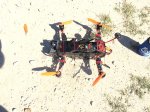
Here's what things looked like after that unfortunate incident with the power line at the beginning of the video. Gopro is fine, just need to replace the protective lens. The FPV camera above it is toast thought, it looks like it took the brunt of the impact...

RattlesnakeDan
San Antonio Texas
LSB TURKEY BUZZARD PRESERVATION SOCIETY
SUS VENATOR CLUB
LoneStarBoars Supporter
Wow, you don't use a case for your Gopro huh? Ouch!
Ratdog68
LSB Official Story Teller
LSB TURKEY BUZZARD PRESERVATION SOCIETY
SUS VENATOR CLUB
LoneStarBoars Supporter
Yikes !! I wondered about that intro... but didn't realize it was the same outing. Smacked things around pretty good. I think that's the first one I've seen built with the layers oriented vertically, rather than horizontally (for the build). Ya got that whole air-borne dirt buggy look going on with it.

Too heavy, I do use one when I'm flying over water I may be able to retrieve it from. The more weight you can remove the better with these things.Wow, you don't use a case for your Gopro huh? Ouch!
Thanks, its definitely a new twist on the standard design. A couple buddies in Dallas and I designed it. The side panels give everything MUCH more protection and durability than the average frame.Yikes !! I wondered about that intro... but didn't realize it was the same outing. Smacked things around pretty good. I think that's the first one I've seen built with the layers oriented vertically, rather than horizontally (for the build). Ya got that whole air-borne dirt buggy look going on with it.